
AC Compressor Not Working: Repair or Replace?
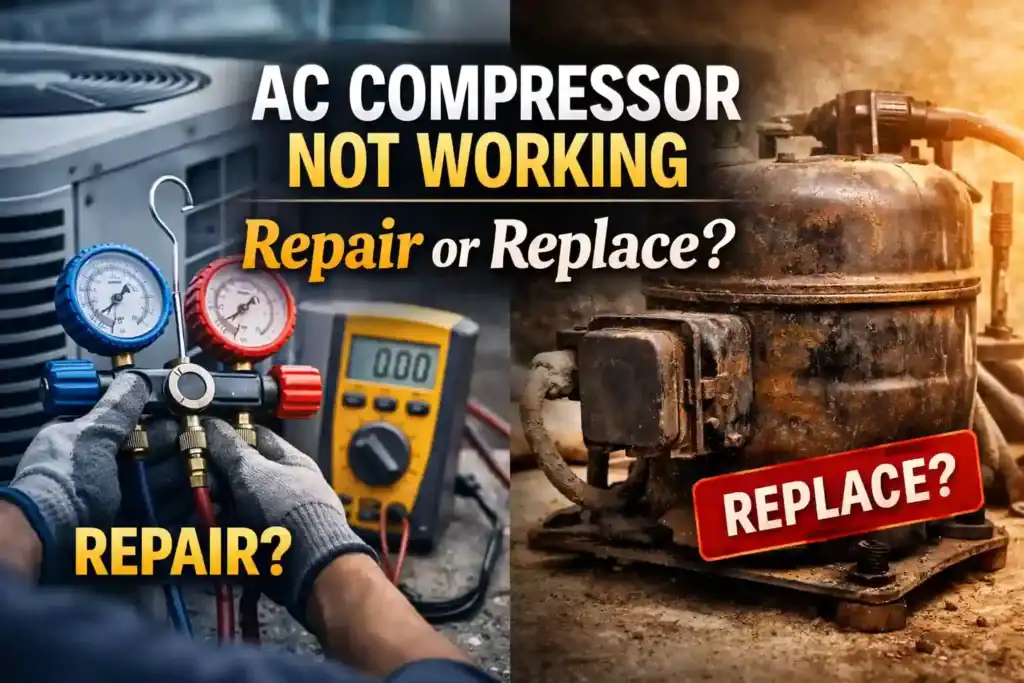
AC Compressor Not Working – Repair or Replace (The Expert Guide Homeowners Actually Need)
When an air conditioner stops cooling, most people assume the “AC is dead.”
But in real life, the system usually fails in predictable ways — and the compressor is often blamed even when it isn’t the real problem.
The compressor is the heart of your AC.
If it’s not working, the unit can’t move refrigerant properly, which means no cooling, high power bills, and repeated breakdowns.
The big question is:
Should you repair the compressor, or replace the entire AC system?
This guide breaks it down like a real technician would — with causes, practical diagnosis, realistic costs, common mistakes, and the exact situations where repair makes sense vs when replacement is the smarter long-term move.
What the AC Compressor Does (And Why It’s So Critical)
Problem: Your AC runs but doesn’t cool, or it won’t start at all.
Cause: Many AC failures are electrical or airflow related, but the compressor is the component that actually pumps refrigerant.
The compressor:
Pulls low-pressure refrigerant vapor from the indoor coil
Compresses it into high-pressure vapor
Pushes it to the outdoor condenser coil to release heat
Keeps the refrigeration cycle moving continuously
Solution: If the compressor is not running, the refrigeration cycle stops — and the AC becomes a fan only.
Real-world example:
You set the thermostat to 22°C. The indoor fan runs. You hear the outdoor unit hum, but no cold air comes. That’s a classic “compressor not running” symptom — but not always a dead compressor.
Prevention:
Regular cleaning, stable voltage, and correct refrigerant charge prevent most compressor damage.
Signs Your Compressor Might Not Be Working (And What They Actually Mean)
Many people jump straight to “compressor is damaged.”
But different symptoms point to different causes.
1) AC Blowing Warm Air
Problem: Air is flowing but it’s not cold.
Cause: Compressor may not be compressing refrigerant, or refrigerant flow is blocked.
Solution: Confirm outdoor unit operation, pressures, and amperage.
Mistake:
Replacing the compressor when the issue is actually low refrigerant from a leak.
2) Outdoor Unit Turns On, Then Shuts Off Quickly
Problem: Short cycling.
Cause: Overheating, capacitor failure, weak contactor, pressure switch trip, or compressor overload.
Solution: Check capacitor, airflow, coil condition, voltage, and refrigerant pressure.
Tip:
A compressor that stops after 10–30 seconds may be protected by an overload — not necessarily “burnt.”
3) Loud Humming, Clicking, or Buzzing
Problem: Outdoor unit makes noise but compressor doesn’t start.
Cause: Usually capacitor failure or locked rotor.
Solution: Replace capacitor first (if tested bad). If locked rotor continues, compressor may be seized.
Example:
You hear “bzzzz… click… bzzzz… click.”
That is extremely common with a failed start capacitor.
4) AC Trips the Breaker When It Starts
Problem: Breaker trips instantly or within seconds.
Cause: High starting current from a locked compressor, shorted winding, or wiring fault.
Solution: Test compressor windings, insulation resistance, and check wiring and contactor.
Mistake:
Installing a bigger breaker. This is dangerous and can cause fire.
5) Outdoor Fan Runs But Compressor Doesn’t
Problem: Fan works, compressor doesn’t.
Cause: Capacitor issue, contactor issue, compressor overload, or internal compressor failure.
Solution: Electrical diagnosis before any major replacement.
The Most Common Reasons an AC Compressor Stops Working
This section matters because the “repair or replace” decision depends heavily on why the compressor stopped.
1) Failed Capacitor (Most Common, Most Misdiagnosed)
Problem: Compressor doesn’t start, outdoor unit hums.
Cause: The capacitor provides the start and run boost needed to start the compressor motor.
Capacitors fail due to:
Heat exposure
Age (typical 2–7 years depending on quality)
Power fluctuations
Cheap low-grade parts
Solution: Replace with the correct microfarad rating and voltage rating.
Example:
A 3-ton AC in Qatar summer: capacitor weakens faster due to extreme heat.
The compressor is fine — it just can’t start.
Tips:
Always use a quality capacitor (not the cheapest one)
Match the exact µF rating
Use higher voltage rating if compatible (e.g., 440V instead of 370V)
Mistakes:
Guessing capacitor value
Replacing without checking fan capacitor side
Not tightening terminals (causes burn marks)
Prevention:
Keep the outdoor unit shaded and well-ventilated when possible.
2) Contactor or Relay Failure
Problem: Thermostat calls for cooling but compressor never gets power.
Cause: The contactor is the electrical switch that sends voltage to the compressor.
Contactors fail due to:
Pitted contacts
Ant nests / insects
Coil burnout
Loose wiring causing arcing
Solution: Replace contactor, tighten connections, and verify correct control voltage.
Example:
Outdoor fan may run if wired differently, while compressor stays off.
Tips:
If the contactor is chattering, the problem may be low voltage from the control circuit.
Mistakes:
Replacing compressor when the contactor isn’t delivering power.
Prevention:
Annual inspection of contactor condition and wiring tightness.
3) Compressor Overload Trip (Heat and Dirty Coils)
Problem: Compressor starts, runs briefly, then shuts off.
Cause: Compressor overheats and the internal overload opens.
This happens when:
Outdoor condenser coil is dirty
Fan is weak or not spinning properly
Refrigerant is overcharged
System airflow is poor
Ambient temperature is extreme
Solution: Clean condenser coil, verify fan speed, check refrigerant charge, improve airflow.
Example:
A unit on a rooftop with direct sun + blocked coil will overheat fast.
Tips:
Clean coil using proper coil cleaner and low-pressure water
Ensure the fan motor capacitor is correct
Don’t “top up” refrigerant blindly
Mistakes:
Cooling the compressor with water and calling it “fixed”
Ignoring the reason for overheating
Prevention:
Keep the outdoor unit clean and give it enough clearance for airflow.
4) Low Refrigerant (Leak) Causing Compressor Damage
Problem: AC cools weakly, then eventually stops cooling.
Cause: Refrigerant leak reduces cooling and also reduces compressor cooling (refrigerant carries oil).
Low refrigerant leads to:
Higher compressor temperature
Poor lubrication return
Internal wear
Overheating and eventual failure
Solution:
Find the leak, repair it properly, vacuum the system, and recharge to factory specification.
Example:
A small leak may let the AC run “okay” for months. Then one day it stops cooling completely.
Tips:
A proper repair is leak test + vacuum + charge by weight
If the technician only adds gas without fixing leak, compressor life drops fast
Mistakes:
Repeated gas refilling
Using wrong refrigerant type
Not replacing filter drier after opening system
Prevention:
Fix leaks early. Don’t delay when cooling performance drops.
5) Electrical Voltage Problems (A Silent Compressor Killer)
Problem: Compressor fails suddenly or repeatedly.
Cause: Voltage fluctuations, low voltage, or phase imbalance (for larger units).
Common in many areas due to:
Weak building wiring
Overloaded circuits
Loose neutral connections
Bad breakers
Generator supply instability
Solution:
Confirm voltage at the compressor terminals under load
Use a proper stabilizer where needed
Fix wiring and tighten terminals
Example:
AC works at night but fails during peak hours.
That’s a classic low-voltage scenario.
Tips:
Install surge protection
Use correct cable size
Never share AC circuit with heavy appliances
Mistakes:
Ignoring voltage and blaming refrigerant
Replacing compressor without fixing electrical issue
Prevention:
Good electrical supply is compressor insurance.
6) Compressor Locked/Seized (Mechanical Failure)
Problem: Compressor hums but cannot start, high amp draw.
Cause: Internal mechanical seizure or worn bearings.
This happens due to:
Overheating
Oil starvation
Liquid floodback (liquid refrigerant returning)
Age and wear
Solution: Replacement is usually required.
Example:
You replaced capacitor twice, contactor is fine, voltage is correct, but compressor still won’t start. That’s often a locked rotor.
Tips:
Hard-start kits may temporarily start a weak compressor, but it’s not a real long-term fix.
Mistakes:
Using hard-start kit as a permanent solution
Ignoring floodback cause (like dirty filter or low airflow)
Prevention:
Maintain airflow, refrigerant charge, and coil cleanliness.
Repair vs Replace: The Real Decision Framework
This is where most homeowners get confused.
Because “repair” can mean:
Small electrical fix (cheap)
Compressor replacement (expensive)
Full system replacement (highest cost, best long-term)
So the correct question is:
Is the compressor actually damaged? And if yes, does replacing it make financial sense?
When Repair Makes Sense (Best Scenarios)
1) The Compressor Is Fine — Only Supporting Parts Failed
Problem: AC not cooling, compressor not starting.
Cause: Capacitor, contactor, wiring, thermostat control issue.
Solution: Replace the failed part.
Example:
Outdoor fan runs, compressor doesn’t. Capacitor tests bad. Replace capacitor — AC works.
Tip:
Always demand a proper diagnosis before accepting “compressor replacement.”
Prevention:
Annual maintenance avoids these failures.
2) The Unit Is Relatively New
If your AC is:
Under 5 years old (excellent repair candidate)
5–8 years old (depends on condition and refrigerant type)
Repair is usually the best option.
Mistake:
Replacing a whole system due to a small electrical fault.
3) The AC Uses Modern Refrigerant and Parts Are Available
If your system uses a commonly supported refrigerant (like R-410A or newer alternatives), compressor replacement may still be a reasonable repair.
When Replacing the Compressor Makes Sense (Not the Whole AC)
A compressor replacement is a major repair, but it can still be smart if the rest of the system is healthy.
Good compressor replacement candidates:
Coil is in good condition
No major corrosion
No repeated refrigerant leaks
Unit is mid-age (5–8 years)
Refrigerant type is still supported
Warranty covers compressor cost
Example:
A 6-year-old split AC in good condition with a compressor that shorted due to voltage surge. Replace compressor + add surge protection.
Tips:
Replace capacitor and contactor at the same time if worn
Install a filter drier
Vacuum properly and charge by weight
Mistakes:
Installing compressor without flushing the system
Not changing the oil type if required
Skipping nitrogen pressure test
Prevention:
Add voltage protection and maintain coil cleanliness.
When Replacing the Entire AC System Is the Better Choice
This is where people try to “save money” and end up spending more.
1) The Unit Is Old (Usually 10+ Years)
Problem: Compressor failed in an old unit.
Cause: Age-related wear, coil corrosion, repeated overheating, inefficient design.
Solution: Replace the entire system.
Example:
You replace the compressor today. Six months later the indoor coil leaks. Now you’ve paid twice.
Tip:
Once an AC passes 10–12 years, major repairs become a gamble.
Prevention:
Plan replacement before peak summer to avoid emergency costs.
2) The AC Has a History of Refrigerant Leaks
Problem: AC needs gas refilling repeatedly.
Cause: Coil leak or flare joint leak not properly repaired.
Solution: Replace system or at least replace the leaking coil — not the compressor alone.
Example:
A compressor died because the system ran low on refrigerant for months. Replacing compressor without fixing leak guarantees another failure.
Mistakes:
“Top up gas” every month
Using sealants that contaminate the system
Prevention:
Fix leaks properly the first time.
3) Your System Uses an Older Refrigerant That’s Hard to Service
If the system uses an older refrigerant that is expensive or difficult to source, replacing the whole system is often the smarter move.
Tip:
Even if you repair it today, future servicing becomes costly.
4) Compressor Burnout Contaminated the System
Problem: Compressor windings burn, oil becomes acidic, system gets contaminated.
Cause: Electrical short or severe overheating.
Solution: Full replacement is often safer than compressor-only repair.
Example:
A burnout spreads carbon and acid through the refrigerant lines and coil. Even after replacing compressor, contamination can destroy the new one.
Tips:
Acid test the oil
Use suction line filter driers if attempting repair
Flush properly
Mistakes:
Installing a new compressor in a contaminated system
Prevention:
Protect electrical supply and maintain cooling performance.
Cost Reality: What You’re Really Paying For
Prices vary by region, brand, and AC type, but the logic stays the same.
Minor Repairs (Usually Worth It)
Capacitor replacement
Contactor replacement
Wiring repair
Fan motor capacitor
Control board issues
These are generally low-to-medium cost and extend life significantly.
Major Repair: Compressor Replacement
This is expensive because it includes:
Compressor part cost
Refrigerant recovery
Brazing and labor
Vacuum and leak test
Refrigerant recharge
Filter drier replacement
System cleanup
Full System Replacement
Higher upfront cost but often better value because you get:
New compressor + coils
New warranty
Better efficiency
Lower risk of repeated breakdowns
Expert tip:
If compressor replacement cost is more than 40–50% of the price of a new system, replacement usually makes more sense.
A Technician’s Checklist: How to Confirm the Compressor Is Actually Bad
A compressor is expensive.
So diagnosis must be real — not guesswork.
Step 1: Confirm Power Delivery
Is voltage reaching compressor terminals?
Is contactor pulling in?
Any burnt wires or loose connections?
Step 2: Test Capacitor
Correct µF reading
No bulging, leaking, or weak value
Step 3: Check Amp Draw
Normal running amps?
Locked rotor amps (LRA) spiking?
Step 4: Test Compressor Windings
Resistance readings
Short to ground test (megger is best)
Step 5: Refrigerant System Check
Pressure readings
Superheat and subcooling
Signs of restriction or overcharge
Mistake:
A lot of “compressor dead” diagnoses are made without doing steps 3–5.
Real-World Scenarios: Repair or Replace?
Scenario A: 3-Year-Old Split AC, No Cooling
Outdoor fan runs
Compressor doesn’t start
Capacitor is weak
Best decision: Repair (capacitor replacement)
Scenario B: 7-Year-Old AC, Breaker Trips
Compressor draws extremely high amps
Windings test shorted
Best decision: Compressor replacement can be worth it if coils are healthy.
Scenario C: 12-Year-Old AC, Compressor Burnout
Oil is black
Strong burnt smell
System had leak issues before
Best decision: Replace the full system
Scenario D: Compressor Replaced 1 Year Ago, Still Problems
Unit overheats
Outdoor coil clogged
Voltage drops during peak hours
Best decision: Fix root cause, not another compressor.
Expert Tips to Make Any Repair Last Longer
Even the best repair fails if the system is unhealthy.
Do these every year:
Clean outdoor condenser coil
Wash indoor filters monthly
Check drain line
Inspect wiring terminals
Confirm refrigerant charge (only if needed)
Add protection if your area has voltage issues:
Surge protector
Voltage stabilizer (where appropriate)
Correct breaker and wiring size
Keep airflow strong:
Don’t block return vents
Use correct filter type (not overly restrictive)
Clean evaporator coil when dirty
Common Mistakes Homeowners Make (That Kill Compressors)
1) Running AC With Dirty Filters
This reduces airflow, causes low evaporator temperature, and can lead to liquid refrigerant returning to the compressor.
2) Ignoring Weak Cooling for Months
Weak cooling is often the first warning sign of low refrigerant or coil issues.
3) Refilling Refrigerant Without Fixing Leaks
This is one of the fastest ways to destroy a compressor.
4) Using Cheap Parts
Cheap capacitors and contactors fail quickly — especially in hot climates.
5) Hiring Technicians Who Don’t Diagnose Properly
A compressor should never be replaced based on “sound” or guessing.
How to Prevent Compressor Failure in the Future
Compressor failure is usually preventable.
The most effective prevention steps:
Keep coils clean
Maintain proper refrigerant charge
Fix leaks early
Protect against voltage fluctuations
Ensure outdoor unit has airflow clearance
Service the system before peak summer
Realistic advice:
If you’re in a very hot region, treat AC maintenance like car maintenance.
You don’t wait for the engine to seize before changing oil.
Repair or Replace: The Final Rule-of-Thumb
If your AC compressor isn’t working, the smartest decision depends on:
Age of the system
True cause of failure
Condition of coils and refrigerant system
Cost comparison
Future reliability
A simple decision guide:
If it’s an electrical component: repair
If the compressor is weak but system is healthy: compressor replacement can work
If the system is old, leaking, or contaminated: replace the whole system
FAQ: AC Compressor Not Working – Repair or Replace?
1) How do I know if my AC compressor is bad or it’s just the capacitor?
If the outdoor unit hums, clicks, or struggles to start, a failed capacitor is very common.
A proper technician will test capacitor µF value and confirm voltage at the compressor before calling it “bad.”
2) Can a compressor be repaired without replacing it?
In most residential systems, compressors are sealed units.
That means internal mechanical repairs are not practical. The “repair” is usually replacing the compressor or fixing the supporting parts causing it not to run.
3) Is it worth replacing a compressor on a 10-year-old AC?
Usually no — unless the system is in excellent condition and the repair cost is very low.
On a 10+ year unit, coils, fan motors, and leaks become more likely, so full replacement often gives better long-term value.
4) What causes an AC compressor to fail suddenly?
The most common causes of sudden compressor failure are:
Voltage surge or low voltage damage
Overheating due to dirty condenser coil
Refrigerant leak leading to oil starvation
Electrical short in windings
5) Can low refrigerant destroy the compressor?
Yes. Low refrigerant often means low oil return and poor cooling of the compressor motor.
If the system runs low for long periods, the compressor can overheat and fail.
6) Should I replace the whole AC if the compressor is locked?
If the system is older, has leak history, or uses outdated refrigerant, replacing the whole AC is usually the safer choice.
If the unit is mid-age and healthy, compressor replacement may still be worth it.
7) How can I prevent compressor failure in hot climates?
In hot climates, compressor protection comes down to:
Clean outdoor coils
Monthly filter cleaning
Correct refrigerant charge
Surge/voltage protection
Preventing airflow blockage
A small maintenance routine can add years to compressor life.